Do You Have to Know How to Convert Binary for Ap Cs
Nosotros are all consumers of calculator science. Whether we hail an Uber ride, play a game, attend a remote grade, or post to social media, nosotros are consuming code. If you want to exist a producer instead of a consumer, AP® Figurer Scientific discipline is the course for you! Informatics teaches computational thinking and the 21st century skills that are essential for the Stem pipeline. Companies want people who can apply programming skills to solve bug. Taking AP® Information science will give you these skills.
There are two different AP® Exams in Computer science. The AP® Information science A examination uses the programming language Java . The AP® Computer Science Principles exam is not language specific. In addition to traditional questions, there is a performance job where you will develop a figurer program and communicate what your code does.
Read on to learn how to report for the AP® Computer science examination and AP® Information science tips that will aid you develop an AP® Estimator Science study plan and gain a top score!
Overall How to Study for AP® Reckoner Science: 9 Tips for 4s and 5s

Tips for the AP® Computer Science A Exam
ane. Know the format of the exam.
The AP® Computer science A exam is 3 hours long and consists of two sections: multiple-choice and free-response. On the multiple-choice section, you accept 1 hour and 30 minutes to answer xl questions. For the complimentary-response department, you have i hour and 30 minutes to answer four questions. Keep in listen that both sections are given equal weight, so they are both every bit important to your overall exam score.
The AP® Informatics Principles exam consists of two sections: There is a traditional multiple-choice section taken in May and a performance task which is completed over the class of the year. On the multiple-choice section, you have 2 hours to reply seventy questions. The performance tasks involve writing a computer program to solve a trouble and submitting a digital portfolio of your piece of work. The digital portfolio consists of a video, written responses, and the actual code.
two. Exist aware of the goals of the test.
According to the College Board's Calculator Science A Course Description , the goals of the AP® CS grade include:
- Designing programs and developing algorithms to solve bug.
- Using logic to decide the output, value, or upshot of given programme code given initial values.
- Writing and implementing plan lawmaking.
- Running, testing, and debugging programming code including analyzing program code for correctness, equivalence, and errors.
- Documenting lawmaking to describe the beliefs and conditions that produce the specified results in a plan
- Agreement the ethical and social implications of computer use
According to the College Board'due south Information science Principles Course Description , the goals of the AP® CS-P form include:
- Making connections between concepts in calculating
- Applying abstractions in computation and modeling
- Communicating ideas almost engineering and computation
- Designing a program to solve a problem or complete a task
- Analyzing computational work
- Working collaboratively to solve bug
In improver to this list of goals, the College Board also offers a topic outlines for the AP® Information science courses. This outline, which you should review on the AP® Reckoner Science A website or the AP® Information science Principles website , shows you exactly what you should know for the exam. The main topics are:
AP® Information science A
- Types and Objects
- Boolean Expressions
- Writing Classes
- Arrays
- Inheritance
- Recursion.
AP® Information science Principles
- Creative Evolution
- Information
- Algorithms and Programming
- Computing Systems and Networks
- Impact of Calculating
Read through the commentary of the topic outline to get a feel for what the form (and test) is all most. A good score on the test will open doors and prove that y'all are someone familiar with those topics which is what employers and colleges are looking for!
3. Invest in a good review resources.
Albert has great AP® Information science practice tests and ane of the largest libraries of fully explained questions for AP® Figurer Science A. Y'all can employ u.s. for getting hundreds of practice repetitions in, along with detailed explanations to help you learn from your mistakes and better focus on our weaknesses.
Barron's seems to be the nigh widely praised AP® Information science study guides since information technology comes with updated practice tests and questions that are challenging, however accessible. Another highly recommended review volume, by teachers and students akin, is AP® grader Maria Litvin's Be Prepared for the AP® Calculator Science Test in Java .
When it comes to the AP® Estimator Science Principles class, Barron's also has a great AP® Information science Principles study guide. Some other highly recommended review book, by teachers and students alike, is five Steps to a 5 AP® Information science Principles by Julie Sway.
Many students attribute their success on the exam to reading through review books and answering the practice questions that come with them. If you lot're looking for more than thorough reviews of AP® Informatics written report guides, this site goes over AP® Informatics A and AP® Computer Science Principles books here.
iv. Take free online courses.
edX offers a two-office course called Preparing for the AP® Informatics A Test . You tin enroll for complimentary at any fourth dimension. Take advantage of this resource! In the course, you'll learn about variables, atmospheric condition, Booleans, and more, equally well as have access to multiple-pick questions, "mixed-up code that the user drags into the correct society," and the ability to solve existent-globe problems.
edX also offers a XSeries plan in CS50's AP® Computer Science Principles . In the grade, you'll learn concepts like abstraction, algorithms, data structures, encapsulation, resource management, security, software engineering, and spider web evolution. Yous will learn how to develop and nowadays a terminal programming projection to your peers.
There are also several other free courses that may acme your interest, including Introduction to Programming with Java Role ane: Starting to Code with Coffee . UC Berkeley as well has a grade chosen The Beauty and Joy of Computing – AP® CS Principles .
All of these courses are cocky-paced which means you can complete them whenever you lot have extra written report time.
v. Picket AP® Information science videos.
If you accept a hard time staying focused when reading textbooks and review books, give videos a try. They tin aid suspension upward the monotony of sitting downward and reading folio subsequently page, and tin besides help explain things in different means.
Educator.com on YouTube has a series of AP® Calculator Science videos, covering everything from conditional statements to arrays, and from classes & objects to algorithms. Additionally, if you're having a hard time agreement a specific concept you lot read about in your book, take to YouTube and expect for a video that explains things in a way you empathize. Informatics can ofttimes feel very abstract, so it'southward helpful to see audiovisual explanations.
The College Board has a series of AP® Information science Principles videos, covering everything from creating the performance task, data abstraction, iteration and selection statements.
As yous sentry the videos, retrieve nigh the algorithms that are used to create the videos. What special furnishings do you run across? What patterns do you notice?
6. Follow social media accounts.
Near people use social media. When information technology comes to social media similar many things informatics related yous can exist either a consumer or a producer. With a background in estimator science, you lot can be a producer and work at a social media company and write the code that makes social media happen. Every bit such, y'all can find a huge variety of computer science related social media accounts to follow.
The accounts that will be helpful to you lot depend on your level of noesis and what you want to know more nigh. You can follow @CompSciFact or Java programming Twitter accounts , "similar" Code.org on Facebook, or follow computer_science_engineers on instagram. When you lot employ social media, think about the calculator science under the hood that makes it happen.
7. Empathize how much coding you need to know.
A mutual question many AP® Reckoner Science students accept is "exactly how much coding exercise I need to know for the test?"
On the test, yous will exist using Java, simply more specifically the methods from the Java Quick Reference as laid out past the College Board. Make certain yous review the College Board's AP® Estimator Scientific discipline A Coffee Quick Reference . The Coffee Quick Reference lists the accessible methods from the Java library that may exist included on the examination, starting with the 2019-20 school year. The Java Quick Reference is included in the exam booklet.
The AP® CS Principles exam is not language specific, just you demand to sympathise basic coding concepts. Make sure you review the AP® Computer science Principles Test Reference Sheet for a summary of these concepts. You don't really want to employ annihilation outside of this reference sheet on the test, although you lot won't exist docked if you do.
8. Practice!
The only way yous can really be prepared for the AP® Computer science exam is through practice, practice, do. You should have full length AP® Computer science practice tests. But how should you exercise? First off, write code! Try to write some well documented code every day. The more exercise you accept in writing and documenting your code, the ameliorate understanding you will have. By documenting your lawmaking, yous are explaining information technology to others and thus will be better able to communicate your agreement of calculator scientific discipline concepts.
Next, do the multiple selection questions. Yous can find dozens of sample multiple-choice questions in the AP® Classroom . Be sure to check out AP® Computer science A and AP® Computer Science Principles on Albert which has hundreds of practise questions organized past topic.
ix. Know what materials are given to you on the examination.
For both the Computer science A and Computer science Principles exams y'all volition be given a reference sheet, either the Coffee Quick Reference or the CS Principles Test Reference Sheet . You tin use this reference at any time during the exam. Remember that this reference is not a substitute for actually knowing and agreement how to implement the classes and interfaces.
Return to the Table of Contents
AP® Information science Multiple-Choice Review: 4 Tips
1. Be familiar with the format of the AP® CS multiple-selection section.
Both the Computer science A and Computer science Principles exams have a multiple option department. The length, number and weighting between the two exams is different. The Calculator Science A exam has 40 questions and is worth 50% of the exam. The questions are single-select questions where you select 1 reply from 4 options. The Computer science Principles exam has 70 questions and is worth 70% of the exam.
When you lot think about it, each question is worth about one% of the test. With the Information science Principles examination, some of the questions are multiple-select multiple-choice: You select two answers from iv options. The Computer Scientific discipline Principles examination likewise has the traditional single-select questions.
2. Know the concepts covered on the exam.
According to the College Board, multiple-choice exam questions can exist classified according to certain categories. On the Computer science A exam, these 10 categories are called units.
The top units which you should focus your studying on include boolean expressions, provisional statements, iteration, and arrays. If yous were to focus on only those topics you would be prepared for over 50% of the material on the exam.
In the Computer Science Principles exam, these 5 categories are called Large Ideas. The pinnacle big ideas are algorithms, programming, data, and the impacts of calculating. Focusing on just those ideas is 85% of the cloth on the examination.
Y'all should study all of the topics, but your focus should be on the higher up areas. It's important that you wait over this table to see which questions are tested the nearly. If you lot use an online review site Albert , you can select to report questions from 1 specific category and spend the appropriate corporeality of time preparing in each category.
| Computer science A Exam Unit | Weighting |
| Unit 1: Primitive Types | 2.5–5% |
| Unit 2: Using Objects | 5–7.5% |
| Unit three: Boolean Expressions and if Statements | 15–17.five% |
| Unit 4: Iteration | 17.v–22.5% |
| Unit 5: Writing Classes | v–vii.5% |
| Unit vi: Assortment | 10–xv% |
| Unit 7: ArrayList | 2.5–seven.five% |
| Unit 8: second Array | seven.5–x% |
| Unit nine: Inheritance | 5–10% |
| Unit x: Recursion | v–7.5% |
| Computer Science Principles Exam Big Ideas | Weighting |
| Big Idea one: Artistic Development | 10–13% |
| Big Thought 2: Information | 17–22% |
| Large Idea 3: Algorithms and Programming | 30–35% |
| Big Thought iv: Computer Systems and Networks | xi–15% |
| Large Idea 5: Impact of Computing | 21–26% |
Note: Full percent is greater than 100% because some questions can be classified in more than one category.
3. Employ standard multiple-choice test-taking strategies.
The multiple-option section of the AP® Information science test can be overwhelming. Y'all have express time and many complex questions to analyze and answer. Sometimes, the best thing to do is take a deep jiff and remember some of the essential multiple-choice test taking strategies. You're probably aware of some of these, merely information technology's still worth reminding y'all.
- Reply EVERY question, even if it'south only a complete estimate. You lot volition non be docked for providing a wrong answer. If y'all had the fourth dimension to read the question, you have time to make an educated judge. Look for keywords and terms related to the concepts.
- Fifty-fifty without knowing the right answer, retrieve of the type of answer you are looking for. For instance, are you lot looking for an integer or a cord? Are you looking for a Boolean argument or a recursive control?
- Read all of the answer choices before making your final decision.
- Use the process of elimination to narrow down your choices. If you lot tin narrow it downward to 2 choices, yous take a l% risk of choosing the correct answer, equally opposed to a 25% adventure.
- Keep track of the time. Brand certain yous glance at your lookout every so oft to brand sure you're not running out of fourth dimension.
- Remember that a car scores this section of the exam, and so make sure you're filling in the answer choices fully and darkly.
- Use the bachelor space for any necessary scratch work. Go on in mind, all the same, that no credit will be given for anything written in the exam booklet.
- Feel costless to mark up the question. Circle or underline if it helps.
- Depending on your examination-taking mode, reading the question before even looking at the possible answer choices may work best for you lot. Conversely, looking at the answer choices and and so reading the question may work best. Detect a mode that works for you.
4. Know what a typical multiple-choice question looks like.
Practicing by taking multiple exercise exams over the course of the year is the best way to become comfortable and confident with this section of the test. The majority of questions will include a snippet of code, which you will have to clarify in one way or another. For example:
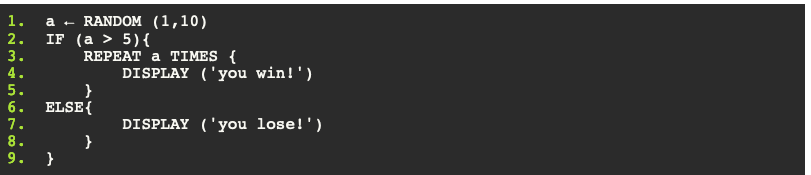
Which line of code above includes a Boolean expression?
A) Line 1
B) Line 2
C) Line 3
D) Line 4
Sometimes you will exist given an output and have to choose the lawmaking segment that produces that output.
For example: A student enters an integer, x, into a program. Which of the post-obit expressions makes sure that ten is an integer betwixt 10 and 20 inclusive? Select 2 answers.
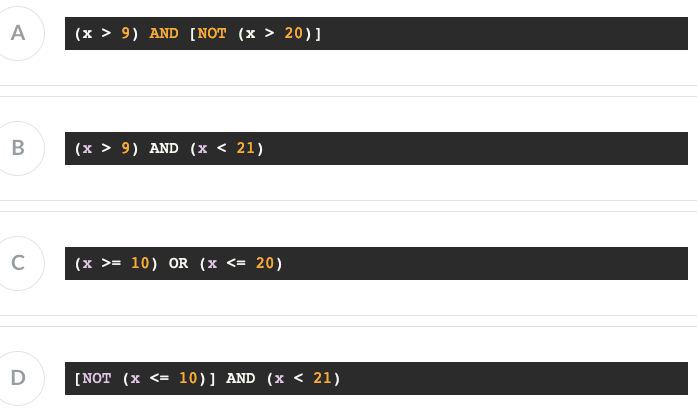
Other times, you may be asked to predict what a particular code segment will print out. More than complex questions might inquire you lot to change segments of code to perform a specific task, evaluate recursion methods, depict what volition happen when a code segment is executed, and analyze lawmaking that may accept many correct answers. Take a look at the sample Informatics A or Estimator Science Principles multiple-pick questions on Albert to go a feel for the complexity of the questions you might see on the exam.
Return to the Table of Contents
AP® Computer Scientific discipline Principles Operation Job Tips
1. Collaborate with your peers.
The performance chore is based on collaborative work that you practice in class. Make sure you actually collaborate when you work on the task. This means sharing your ideas with others and combing ideas with your peers to create new ideas that neither of y'all would accept come up with on your own. This post in EdTechReview has suggestions for successful collaboration.
2. Choose a challenge or problem to solve that interests you.
The more excited you are about a topic, the more effort you lot will put into the projection. If you are non interested in the topic, so the project will be a job instead of a capstone projection.
3. Make sure your code includes all of the requirements.
Your code should include:
- Instructions for input
- Collection of data in lists
- A procedure
- Sequencing, pick, and iteration
- Instructions for output
4. Get ready to present your code with a video.
Don't wait until the last week to practice using video software to create the video. Endeavour different software (such equally Screencastify , Camtasia , iMovie, Adobe Premier Pro , or Discourse ) and choose one that works best for yous.
Practice with the software well before you lot need to actually create your video. Make sure you write a storyboard for your video well in advance of doing the piece of work in class. Make certain your video adheres to the guidelines:
- one min max
- No voice narration
- Demonstrates input, output, and functionality,
- Proper size and format
If your initial video does not meet these requirements, that is okay. That is the beauty of video editing. You can easily alter the format of your video and reduce the size of your file by irresolute the resolution. Captions can be used instead of narration. By cutting out sections it is like shooting fish in a barrel to go down to 1 minute. But by practicing with video software early, you lot will not take to acquire these tricks at the concluding infinitesimal.
5. Practice writing brief written responses.
Information technology is much harder to be thorough and curtailed than to write a lot. There are three written responses and the maximum you can write is 750 words. Assume your reader is educated in information science and yous practise non need to explain Information science to them. You demand to explicate and communicate your work, that your program accomplishes the tasks, and that you understand information technology.
half-dozen. Understand how the Performance Chore is scored.
Review the scoring guidelines which are on the College Board website. Consider the offset bespeak in the rubric for Programme Purpose and Function .
A common fault is not taking advantage of the video medium and showing the program really running. Screenshots are not good plenty, you need to include the visual results of the lawmaking.
vii. Look at older educatee portfolios.
Expect at sample students portfolios and how they were scored. Go on in mind that in the older Information science Principles examination at that place were 2 sections of the performance job, a Create and a Explore . Starting in 2021 there volition only exist 1 section, the Create Performance task . Look at the content of the videos and the written responses. The older tests (2018 and 2017) have Commentary on the Create sections. If yous look at how the exam is graded, you volition see that the portfolios either earn the betoken, or they don't. The beginning few samples in 2018 have perfect scores, just later that y'all will see variation. 1 mutual error is whether or non the responses can clearly place two algorithms used in the code and how they relate to the overall function of the code.
Return to the Table of Contents
AP® Computer science A Free-Response Tips

1. Avoid the twelve nigh mutual errors.
In CS, you lot will brand mistakes. It comes with the territory. Even so, as long as you are aware of the most mutual mistakes and errors, yous can hopefully avoid them on the free-response section of the test. The most common errors include:
- Beingness off by one in loops
- Not initializing a variable
- Failure to return a required value
- Using the wrong identifier
- Non returning a statement in a non-void method
- Modifying a constant
- Using local variables but not declaring them
- Missing { }, (), or semicolons
- Including extraneous code that causes side effects
- Confusing = with ==
- Confusing [] with ()
- Assigning values incorrectly (putting ten + 2 = y, instead of y = ten + 2)
2. Write legibly, conspicuously, and with good programming manner.
It'southward always important to call up that humans will exist grading the gratuitous-response section of the AP® Informatics A test. This means y'all should aim for clarity in your programming responses. You desire your responses to be every bit like shooting fish in a barrel to grade as possible. Go along in heed the following when writing your programming responses:
- Assign meaningful variable names
- Write neatly and legibly
- Ever indent properly (this is a big ane considering if you accidentally miss a curly brace or semicolon, proper indentation volition salve you)
- Position curly braces clearly
- Keep it organized
- Utilize white infinite liberally
- Do not write too small or too large
- Put each statement on a split up line
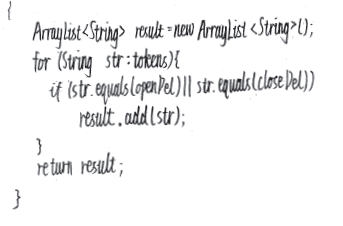
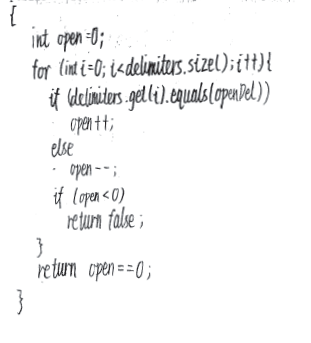
This 2019 response from a existent AP® Computer Science test-taker shows what a dandy, legible response with good programming way looks like. This response actually earned a score of 9!
iii. Do not apply specific numbers, strings, or dimensions of arrays in your code.
You lot want to make your program work with any potential number, string, or dimension, not just the one given to y'all equally an case in the question. This is a common error that many AP® CS students make.
For example, if a question is about a two-dimensional array and it shows yous an paradigm of a iii by 4 array, do not use the numbers iii and 4 in your lawmaking. Instead, depending on what the question is asking, you lot'd want to make your code work with an assortment of any size. Recall, practice not employ specific numbers!
iv. Attempt every part of the question.
Well-nigh AP® Computer Science free-response questions will include multiple parts (office a, part b, part c, etc.). It may surprise y'all that role (a) is usually harder than parts (b) and (c). The problem with this is that many test-takers become discouraged when they don't know how to reply office (a), and so they don't even attempt the other parts. Don't do this!
Each part is graded independently from the previous parts. This means that if you leave part (a) bare or provide an incorrect answer, you could still get full or partial credit for the other parts! Even so, do non re-implement lawmaking from earlier parts in later parts, even if that item code is 100% correct. This is a waste matter of time and you could potentially lose points.
v. Brand sure you've really answered the question.
Sounds like a no-brainer, correct? Non so much. Some students get then defenseless up in their answer that they forget to make sure they're actually addressing the trouble or answering the question. To avert this, underline, circumvolve, or star important details when you start read the problem. Reread the question. Look for phrases like "You will receive no credit if…".
When you've finished writing your code, await at the problem again. Await at the data y'all underlined or circled. Did you actually answer the question?
vi. Always write downwards some lawmaking in your respond.
Y'all will be given no credit for merely describing what you would exercise if you had the fourth dimension to write out the lawmaking (this is not an English examination). You could receive some credit, however, for attempting some attribute of the code. You may not know how to write the full code to accost the trouble, but always write at least some code for the parts you lot do. Partial credit may be given for having the correct loop premises, attempting to sum values in an array, etc.
vii. Think that elegance of code does not matter.
For you advanced programmers out there, elegant coding does not count on the AP® CS exam. Don't try and show off, no matter how much you lot want to. Stick to what yous know. You lot could potentially waste matter time trying to write really simple, efficient code, or fifty-fifty play tricks yourself in the process. A creature-force arroyo is all-time on the exam. Comments are not a substitute for writing articulate, simple, and correct code. If y'all need to explicate your code with comments, so it is too complicated.
viii. Stay within the AP® Coffee Quick Reference.
The subset if given to you for a reason. Even if you went outside the subset in your AP® CS class or if you're a Java pro, don't get fancy on the exam. Keep it simple and employ the AP® Coffee Quick Reference .
In particular, simply use the classes on the AP® Java Quick Reference (such as Strings, Integers, Double, Math, ArrayLists, or Objects). There are many other classes such as Data or Sort, but you do not demand them.
nine. Follow Java naming conventions.
A simple tip, but make sure you're naming your methods, variables, and parameters correctly. Commencement names with a lowercase letter and proceed names meaningful but not too verbose. Use your best judgment. For instance, "count" would be better than "a," simply " thou" would exist meliorate than "loopControlVariable." Also, make sure y'all await at the question carefully before naming things in your code. Sometimes the question will incorporate names that you should use in your code.
10. Don't waste time including comments.
Comments are completely disregarded by AP® readers. Y'all will therefore receive no credit for them. Your code should never be and then disruptive that you take to include comments to show the AP® reader what yous're doing. The only fourth dimension you should include comments is if it helps you organize your thoughts and stay on track. Since you'll be nether a time crisis on the AP® Computer Science FRQ, don't waste your valuable fourth dimension on comments.
11. Code according to the specifications and preconditions and postconditions.
Don't code anything outside of the specifications! Y'all don't want to include any "bells and whistles," since yous are likely to lose points if yous do. It's of import to note that yous should never add System.out.print unless you lot are asked to. Additionally, don't include any unnecessary checks to your code.
For a question you might meet on your test, have a look at this question taken from the 2019 AP® Calculator Science Exam . Information technology outlines the specifications, preconditions, and postconditions of a particular trouble:
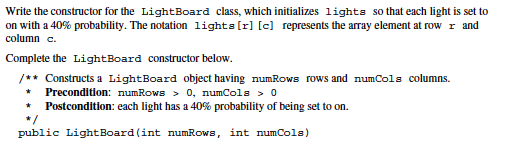
In this question, the LightBoard course models a ii-dimensional display of lights, where each light is either on or off, as represented by a Boolean value. In the question, you would implement a constructor to initialize the display and a method to evaluate a light.
Render to the Table of Contents
Tips by AP® Computer Science Teachers and Students

Tips for Both Figurer Science A and Computer Science Principles exams
1. Don't spend time memorizing specific code.
Having a good conceptual understanding of algorithms is more important than memorizing code. No questions on the AP® CS exam volition ask y'all to regurgitate specific code (for example, searches and sorts). It'southward useful to be able to recognize binary searches, for instance, simply don't spend fourth dimension memorizing code. Thanks to Ms. C. from Lancaster Country Solar day School for the tip!
2. Apply CodingBat for programming practice.
This website created by a Stanford Informatics lecturer offers live coding bug to build skills in Java or Python. You tin go immediate feedback on a huge variety of coding issues, as well as run across solutions and watch videos explaining those solutions. CodingBat is really fun, as well, which makes it a useful report tool. Thanks to Mr. Yard. at Pacific Collegiate Schoolhouse for the tip!
3. Don't just read the textbook.
The exam won't have questions based on vocabulary gleaned from a textbook (like "Polymorphism is…"). Instead there will be questions like ""Co-ordinate to the code to a higher place, if the value of ten is 3, and then what value is returned?" Y'all can't just acquire this from reading a textbook. Information technology'south crucial that y'all do programming exercises and learn to trace code by actually learning to code!
iv. Read other people's code.
Looking at other people's code gives you an insight into someone else's railroad train of thought. Information technology can aid open your heed to other possible solutions to a trouble and other methods and conventions that you may not accept thought most before.
5. Review basic searches and sorts.
You should exist able to identify linear and binary searches, as well equally bubble, insertion, selection, quick, and merge sorts. You don't have to know how to program them, simply you lot should know their basic characteristics.
Specific Java Tips for the AP® Computer Science A exam
1. Be aware of the 3 types of errors.
In that location are three types of errors in student responses: no-deduction errors, ½-point deduction errors, and 1-betoken deduction errors. Thanks to Mr. H. at Granger High School for the tip!
- No-deduction errors are the honest slips of the listen that usually happen equally a outcome of the stresses of the time crunch. Errors like missing parentheses, using = instead of ==, etc. will usually lead to no betoken deductions. Yet, information technology's best to avoid these types of mistakes to get in easier on the AP® reader.
- ½-betoken deductions are for minor errors. If you lot misspell identifiers, misfile brackets with parentheses, or forget to declare local variables, etc., you could lose a ½ point. To avoid these types of mistakes, practise writing code by manus regularly.
- i-indicate deductions are for major errors. These deductions are ofttimes as a issue of not understanding the object-oriented prototype or not understanding the question (extraneous lawmaking, misuse of private information, destruction of information structures, etc.)
2. Avoid the temptation to show off.
For case, don't utilise recursion to do something that tin easily be done iteratively. The AP® readers aren't looking for fanciness. In fact, if you lot practise something offbeat or obscure, the AP® readers can actually misinterpret your answer, leading to lost points. Trying to be clever tin can as well lead to errors and confusion. For these reasons, keep your lawmaking straightforward and conventional. Thank you to Mr. D. at Allegheny College for the tip!
3. Follow proper naming conventions.
Do non use single-letter variable names except for looping variables. Choose variable names that reflect the variable's purpose or telescopic of use. Call back that you're handwriting the code, so avoid using certain letters and numbers that tin get confused (for example, o and 0). Thank you to Mr. H. at Granger Loftier School for the tip!
four. Know the types of questions you tin can await to run across.
Virtually thirty of the twoscore multiple-choice questions will most probable involve tracing code. This tin can exist fourth dimension-consuming so make sure you lot're allowing yourself enough time to get to every question. The other multiple-choice questions might involve Boolean algebra (De Morgan's Law, true/simulated logic), conversion of binary, octal, or hexadecimal to a decimal number, and double-nested loop analysis. Brand sure that you too know how to work with Integer and Double Thanks to Mr. M. from Wyomissing Area High School for the tip!
5. The just fashion to get skilful at writing Java is to practice writing Java.
I had no programming experience when I started AP® CS, and now I've fallen in love with coding. That being said, you lot demand to practise! Set projects for yourself. Intentionally write errors into your program to see how the compiler responds. Expand programming assignments to encounter what you tin can accomplish.
Return to the Table of Contents
Wrapping Things Up: The Ultimate List of AP® Calculator Science Tips
AP® Computer Science may seem impossible at starting time. There are times when you might simply desire to requite upwards completely. But don't go besides overwhelmed! Computer science is a subject that takes fourth dimension and practice. If you've been programming since you were in elementary school, or if you've never fifty-fifty seen a piece of code in your entire life, it'due south possible to become a dandy score on the AP® Calculator Scientific discipline exam. Only focus on these 3 things:
- Write some code to solve a problem every day
- Read and interpret some new code every day
- Practise some multiple choice questions from AP® Computer science exercise tests every day, but choose a different category each week.
Having a AP® Computer science study plan, knowing what to expect on the AP® Estimator Science exam, and practice, practice, practice volition give you lot the best chance at getting a 4 or 5. Skillful luck and good luck preparing for the AP® Computer science exam!
harrisonthomedran.blogspot.com
Source: https://www.albert.io/blog/ap-computer-science-tips/
0 Response to "Do You Have to Know How to Convert Binary for Ap Cs"
Post a Comment